Voorraad laag
Nasiri Books
Al-La Madhhabiyya: Abandoning the Schools of Law | Shaykh al-Buti
Al-La Madhhabiyya: Abandoning the Schools of Law | Shaykh al-Buti
Kan beschikbaarheid voor afhalen niet laden
Al-La Madhhabiyya is Shaykh Muhammad Saʿid Ramadan al-Buti’s detailed defence of the traditional Sunni schools of law and his critique of the call to abandon adherence to the established madhhabs.
The book emerged in response to modern arguments that Muslims should dispense with the traditional legal schools and instead derive rulings directly from the Qurʾan and Sunna without following a particular madhhab.
Shaykh al-Buti examines this claim through the principles of Islamic jurisprudence and argues for the continued legitimacy and necessity of structured adherence to the recognised schools of law.
The question of madhhab and taqlid
At the heart of the book is a major question in modern Islamic legal discourse:
What role should the madhhabs play in the religious life of Muslims?
Al-Buti addresses this through discussions of:
• taqlid and following qualified scholarship
• the authority of the established legal schools
• the difference between qualified ijtihad and lay interpretation
• the historical practice of following jurists and imams
• scholarly consensus concerning legal methodology
• whether a Muslim may move freely between rulings and schools
• the role of the madhhabs in preserving disciplined legal reasoning
The book therefore goes beyond a simple defence of one school. Its subject is the broader methodology of Sunni jurisprudence and the way legal knowledge is transmitted and applied.
A response to anti-madhhab arguments
The work was originally written in response to arguments associated with Muhammad Sultan al-Maʿsumi al-Khajnadi, whose writings circulated under titles such as Should a Muslim Follow a Particular Madhhab? and The Blind Following of Madhhabs.
Shaykh al-Buti analyses several of the claims made in that literature and offers counter-arguments rooted in legal theory, scholarly precedent and the historical practice of Sunni scholarship.
Later editions also incorporate material arising from debates and responses involving figures such as:
• Nasir al-Din al-Albani
• Muhammad ʿId ʿAbbasi
• Mahmud Mahdi al-Istanbuli
• Khayr al-Din Wanli
What the book covers
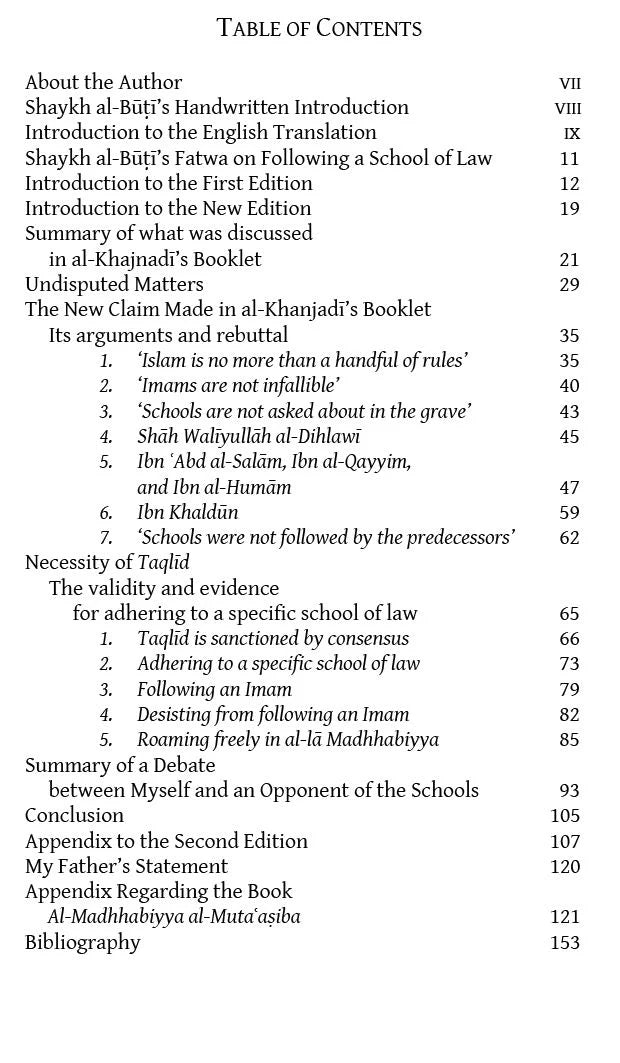
According to the table of contents, the book includes discussions on:
• Shaykh al-Buti’s fatwa on following a school of law
• the arguments presented in al-Khajnadi’s booklet
• disputed and undisputed matters
• the necessity of taqlid
• evidence for adhering to a specific madhhab
• following an imam
• when one may cease following an imam
• al-lā madhhabiyya
• a debate between al-Buti and an opponent of the schools
• later appendices and responses
• bibliographical references
The book is therefore both theoretical and polemical, but remains fundamentally concerned with the principles of legal authority and disciplined scholarship.
About Shaykh Muhammad Saʿid Ramadan al-Buti
Shaykh Muhammad Saʿid Ramadan al-Buti رحمه الله (1929–2013) was a prominent Syrian scholar of Islamic law, theology, legal theory and related disciplines.
Born near the village of Jilka in the region of Butan, he moved with his family to Damascus as a child. He later studied at al-Azhar University and pursued advanced studies in uṣūl al-fiqh.
He went on to teach at Damascus University and held senior academic positions, including Dean and Head of the Department of Beliefs and Religions.
He authored more than forty works on Islamic law, theology and other subjects and became one of the most widely known Syrian scholars of his generation.
Who is this book for?
This work is especially useful for:
• students of fiqh and uṣūl al-fiqh
• readers interested in the history and function of the madhhabs
• students studying taqlid and ijtihad
• readers examining modern critiques of madhhab adherence
• teachers and study circles
• advanced students of Sunni legal methodology
It is more analytical than introductory and is best suited to readers who want to understand the arguments for structured madhhab adherence from within the classical Sunni legal tradition.
An important English-language work for students of fiqh, uṣūl al-fiqh and Islamic legal methodology.
BOOK DETAILS
Title: Al-La Madhhabiyya
Subtitle: Abandoning the Schools of Law is the Most Dangerous Innovation Threatening the Sacred Law
Author: Shaykh Muhammad Saʿid Ramadan al-Buti
Arabic: الشيخ محمد سعيد رمضان البوطي
Translators: M. Merza, M.A. Absi & S. Abdul Aziz
Subject: Fiqh / Uṣūl al-Fiqh / Madhhabs / Taqlid
Language: English
Publisher: Sunni Publications
Place of publication: Rotterdam, The Netherlands
Edition: Second Edition
Year: 2017
Earlier edition: 2007
Pages: 160
Binding: Paperback
Weight: 220 g
ISBN: 978-90-79294-24-4
ISBN-13: 9789079294244
Condition: New
Summary
Al-La Madhhabiyya is Shaykh Muhammad Saʿid Ramadan al-Buti’s defence of the traditional Sunni schools of law and his critique of calls to abandon madhhab adherence. The book examines taqlid, ijtihad, following an imam, legal authority and the methodology of Sunni jurisprudence, while responding to modern anti-madhhab arguments.
NEDERLANDS
Al-La Madhhabiyya
Al-La Madhhabiyya is een Engelstalig werk van Shaykh Muhammad Saʿid Ramadan al-Buti رحمه الله over het volgen van de traditionele islamitische rechtsscholen.
Al-Buti verdedigt de legitimiteit en betekenis van de madhhabs en bespreekt thema’s als taqlid, ijtihad, het volgen van een imam en juridische autoriteit.
Het boek is geschreven als antwoord op moderne oproepen om de traditionele rechtsscholen volledig los te laten en behandelt verschillende argumenten die tegen madhhab-following zijn ingebracht.
Een inhoudelijk werk voor studenten van fiqh, uṣūl al-fiqh en de geschiedenis van de islamitische rechtsmethodologie.
العربية
اللامذهبية
كتاب باللغة الإنجليزية للشيخ محمد سعيد رمضان البوطي رحمه الله في الدفاع عن المذاهب الفقهية المعتبرة ومناقشة الدعوة إلى ترك الالتزام بالمذاهب.
يتناول الكتاب مسائل التقليد والاجتهاد واتباع الإمام وحجية المذاهب والمنهج الفقهي السني، ويرد على عدد من الاعتراضات الحديثة على التمذهب.
وهو كتاب مناسب لطلاب الفقه وأصول الفقه والمهتمين بتاريخ المذاهب ومنهج الاستنباط الفقهي.
Share